


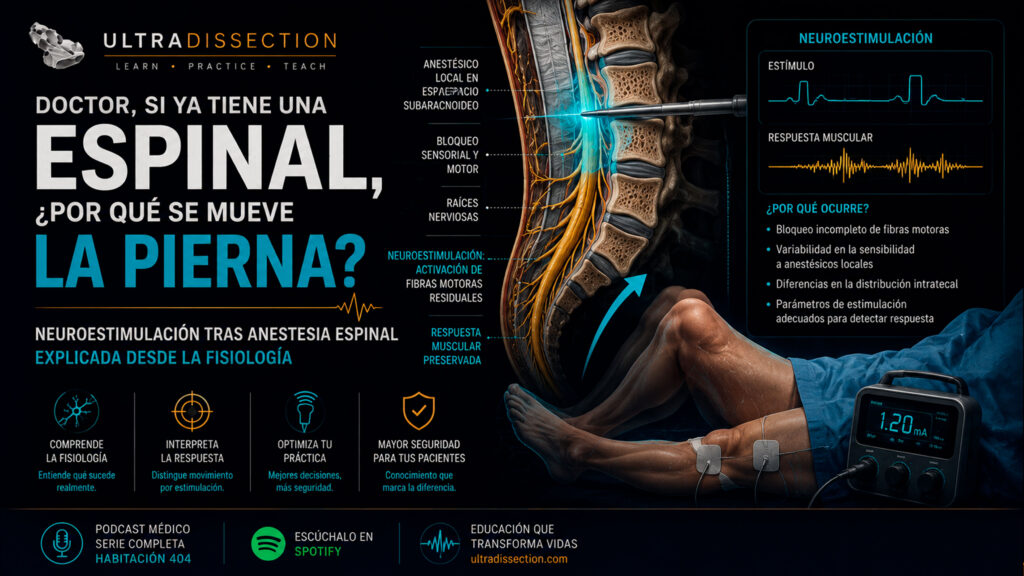
“Doctor, si ya tiene una espinal… ¿por qué se mueve la pierna?” Neuroestimulación tras anestesia espinal explicada desde la fisiología
ULTRADISSECTIONGROUP® | Temporada 3 · Episodio 13
Hay momentos en quirófano que no se olvidan.
No porque algo salga mal… sino porque algo que “no debería pasar”… pasa.
Una pierna completamente bloqueada… que de repente se mueve.
Y ahí empieza el aprendizaje real.
🧠 1. El caso que lo cambia todo
Paciente varón, 72 años, programado para prótesis total de rodilla.
Antecedentes sin relevancia neurológica, buen estado general, dolor intenso al caminar.
El plan anestésico:
- anestesia espinal para la cirugía
- bloqueo femoral para analgesia postoperatoria
Un plan clásico. Lógico. Eficiente.
Hasta que aparece la duda:
¿Tiene sentido hacer un bloqueo periférico si la pierna ya está “muerta”?
⚠️ 2. La escena en quirófano
La espinal es técnicamente perfecta:
- nivel sensitivo adecuado
- Bromage 3
- ausencia total de movimiento voluntario
La cirugía se realiza sin problemas.
Al finalizar, se decide realizar un bloqueo femoral con neuroestimulación.
Se posiciona la aguja, se reduce la intensidad…
💥 Y la pierna se mueve.
Contracción clara del cuádriceps.
El residente se queda en silencio.
“Doctor… ¿no se supone que la espinal está funcionando?”
🧬 3. La clave: entender la vía motora
Para entender lo que ocurre, hay que olvidar la técnica y volver a la fisiología.
Primera neurona motora
- ubicada en la corteza motora
- envía la orden de movimiento
- desciende por el tracto corticoespinal
Segunda neurona motora
- ubicada en el asta anterior de la médula
- sale por la raíz ventral
- forma el nervio periférico
Unidad motora
- nervio periférico
- placa neuromuscular
- músculo
Si la segunda neurona dispara… el músculo se contrae.
🧠 4. Qué hace realmente la anestesia espinal
La anestesia espinal actúa a nivel de:
- raíces nerviosas
- espacio subaracnoideo
Bloquea:
- la transmisión sensitiva
- la transmisión motora
Pero hay algo clave:
NO destruye el nervio periférico.
El nervio femoral distal:
- sigue intacto
- sigue excitable
- sigue conectado al músculo
Simplemente, ha perdido la señal “desde arriba”.
⚡ 5. Qué hace el neuroestimulador
El neuroestimulador cambia completamente el circuito.
No usa la vía fisiológica normal.
Hace esto:
- aplica corriente directamente al nervio
- despolariza la motoneurona inferior
- genera un potencial de acción local
- activa la placa motora
- contrae el músculo
Bypassea completamente la espinal.
💡 6. La analogía que lo explica todo
Imagina una lámpara:
- la espinal es el interruptor del pasillo
- el nervio es el cable
- el músculo es la bombilla
Si apagas el interruptor, la luz no enciende.
Pero si conectas una batería directamente al cable:
💡 La bombilla se enciende igual.
Eso es exactamente lo que hace el neuroestimulador.
🎯 7. Error conceptual frecuente
Muchos interpretan la respuesta motora como:
- fallo de la espinal
- bloqueo incompleto
Pero en realidad:
la respuesta motora confirma que el nervio periférico está vivo.
📌 8. Puntos clave clínicos
- La espinal bloquea raíces, no nervios periféricos.
- La neuroestimulación evalúa excitabilidad distal.
- La vía motora es un circuito en serie.
- Si estimulas distal al bloqueo, puedes generar respuesta.
- No es un test de eficacia de la espinal.
🏥 9. Implicación práctica
Sí tiene sentido realizar un bloqueo periférico tras una espinal.
De hecho, es una combinación muy potente:
- espinal → cirugía
- bloqueo periférico → analgesia postoperatoria
Resultado:
- menos dolor
- menos opioides
- mejor recuperación
📊 10. Evolución del paciente
El paciente:
- despierta sin dolor
- requiere menos opioides
- mejor movilización
Pero el verdadero resultado no está en el paciente…
Está en el residente que entendió lo que vio.
🏁 Conclusión
Cuando una pierna “bloqueada” se mueve con neuroestimulación:
no es un error. Es fisiología en vivo.
La espinal bloquea la comunicación central.
Pero el sistema periférico sigue funcionando.
Y cuando entiendes eso… dejas de memorizar técnicas y empiezas a pensar como anestesiólogo.
“Doctor, if the spinal is working… why does the leg still move?” Neurostimulation After Spinal Anesthesia Explained
ULTRADISSECTIONGROUP® | Season 3 · Episode 13
There are moments in the operating room you never forget.
Not because something goes wrong… but because something that “shouldn’t happen”… happens.
A completely blocked leg… that suddenly moves.
And that’s where real learning begins.
🧠 1. The Case That Changes Everything
A 72-year-old male scheduled for a total knee replacement.
No relevant neurological history, good baseline condition, severe pain when walking.
The anesthetic plan:
- spinal anesthesia for surgery
- femoral nerve block for postoperative analgesia
A classic, logical, efficient plan.
Until the key question appears:
Does it make sense to perform a peripheral block if the leg is already “paralyzed”?
⚠️ 2. The Operating Room Scene
The spinal anesthesia is technically perfect:
- adequate sensory level
- Bromage 3
- complete absence of voluntary movement
The surgery proceeds uneventfully.
At the end, a femoral nerve block with nerve stimulation is planned.
The needle is positioned. Current is reduced…
💥 And the leg moves.
Clear quadriceps contraction.
The resident freezes.
“Doctor… if the spinal is working, why is the leg moving?”
🧬 3. The Key: Understanding the Motor Pathway
To understand this, you must leave technique aside and return to physiology.
Upper Motor Neuron
- located in the motor cortex
- initiates voluntary movement
- descends through the corticospinal tract
Lower Motor Neuron
- located in the anterior horn of the spinal cord
- exits via the ventral root
- forms the peripheral nerve
Motor Unit
- peripheral nerve
- neuromuscular junction
- muscle fiber
If the lower motor neuron fires… the muscle contracts.
🧠 4. What Spinal Anesthesia Really Does
Spinal anesthesia acts at the level of:
- nerve roots
- subarachnoid space
It blocks:
- sensory transmission
- motor transmission
But here is the key point:
It does NOT destroy the peripheral nerve.
The femoral nerve distal to the roots:
- remains intact
- remains excitable
- remains connected to the muscle
It has simply lost the signal from above.
⚡ 5. What the Nerve Stimulator Does
The nerve stimulator completely changes the circuit.
It bypasses the normal physiological pathway.
It does the following:
- applies electrical current directly to the nerve
- depolarizes the lower motor neuron axon
- generates a local action potential
- activates the neuromuscular junction
- produces muscle contraction
It bypasses the spinal block completely.
💡 6. The Analogy That Explains Everything
Imagine a lamp:
- the spinal block is the wall switch
- the nerve is the electrical wire
- the muscle is the bulb
If you turn off the switch, the light does not turn on.
But if you connect a battery directly to the wire:
💡 The bulb lights up anyway.
That is exactly what nerve stimulation does.
🎯 7. Common Misinterpretation
Many interpret motor response as:
- failed spinal anesthesia
- incomplete block
But in reality:
motor response confirms that the peripheral nerve is alive.
📌 8. Key Clinical Points
- Spinal anesthesia blocks roots, not peripheral nerves.
- Nerve stimulation evaluates distal excitability.
- The motor pathway is a serial circuit.
- Stimulating distal to the block can still produce movement.
- It is NOT a test of spinal effectiveness.
🏥 9. Practical Implication
Yes, it absolutely makes sense to perform a peripheral nerve block after a spinal.
In fact, it is a powerful combination:
- spinal → surgical anesthesia
- peripheral block → postoperative analgesia
Result:
- less pain
- less opioid use
- better recovery
📊 10. Patient Outcome
The patient:
- wakes up without pain
- requires fewer opioids
- mobilizes earlier
But the real outcome is not the patient…
It is the resident who finally understood what they saw.
🏁 Conclusion
When a “blocked” leg moves with nerve stimulation:
it is not an error. It is physiology in real time.
The spinal blocks central communication.
But the peripheral system remains functional.
And once you understand that… you stop memorizing techniques and start thinking like an anesthesiologist.